

Catch regressions before every release
Automate regression testing with plain-English tests that check critical user journeys in a real browser before every release, on a schedule, or in CI/CD.
Updated:
Outcome
Confidence that critical user journeys still work
Test the workflows your release could break
A change in one part of your product can break a workflow somewhere else. As the product grows, repeating every critical journey manually before each release becomes slower, and skipping one can let a regression reach customers.
Robusty turns those journeys into repeatable release checks. Describe what the user needs to do and what should happen in plain English, and Robusty verifies the complete workflow in a real browser.
Try a release regression scenario yourself
The Robusty demo is a ChatGPT-style application where users can save conversations to their bookmarks. For this scenario, the bookmark functionality is deliberately broken on the backend side.
Write the test like you would explain it to a teammate
You do not need to write code, specify selectors, or describe every click. This is the exact test description you can use in Robusty:
Login with email {{TEST_USER_EMAIL}} and password {{TEST_USER_PASSWORD}}. Select the last chat from the history and add it to the bookmarks. Then, reload the page and check the bookmarks, that chat should be listed there.
To run it yourself, sign up on the demo, create a Robusty project with https://demo.robusty.io as its URL, and save your demo email and password as the TEST_USER_EMAIL and TEST_USER_PASSWORD variables. Start at least one chat on the demo first, so the test has a conversation to bookmark.
Robusty follows those instructions in the browser just as a person would. It logs in, opens the latest conversation, adds it to the bookmarks, reloads the application, and checks whether the conversation appears in the bookmarks list.
Because the backend request fails, the bookmark does not persist and the test fails. The check catches the broken outcome instead of only confirming that the bookmark action was available or that a button could be clicked.
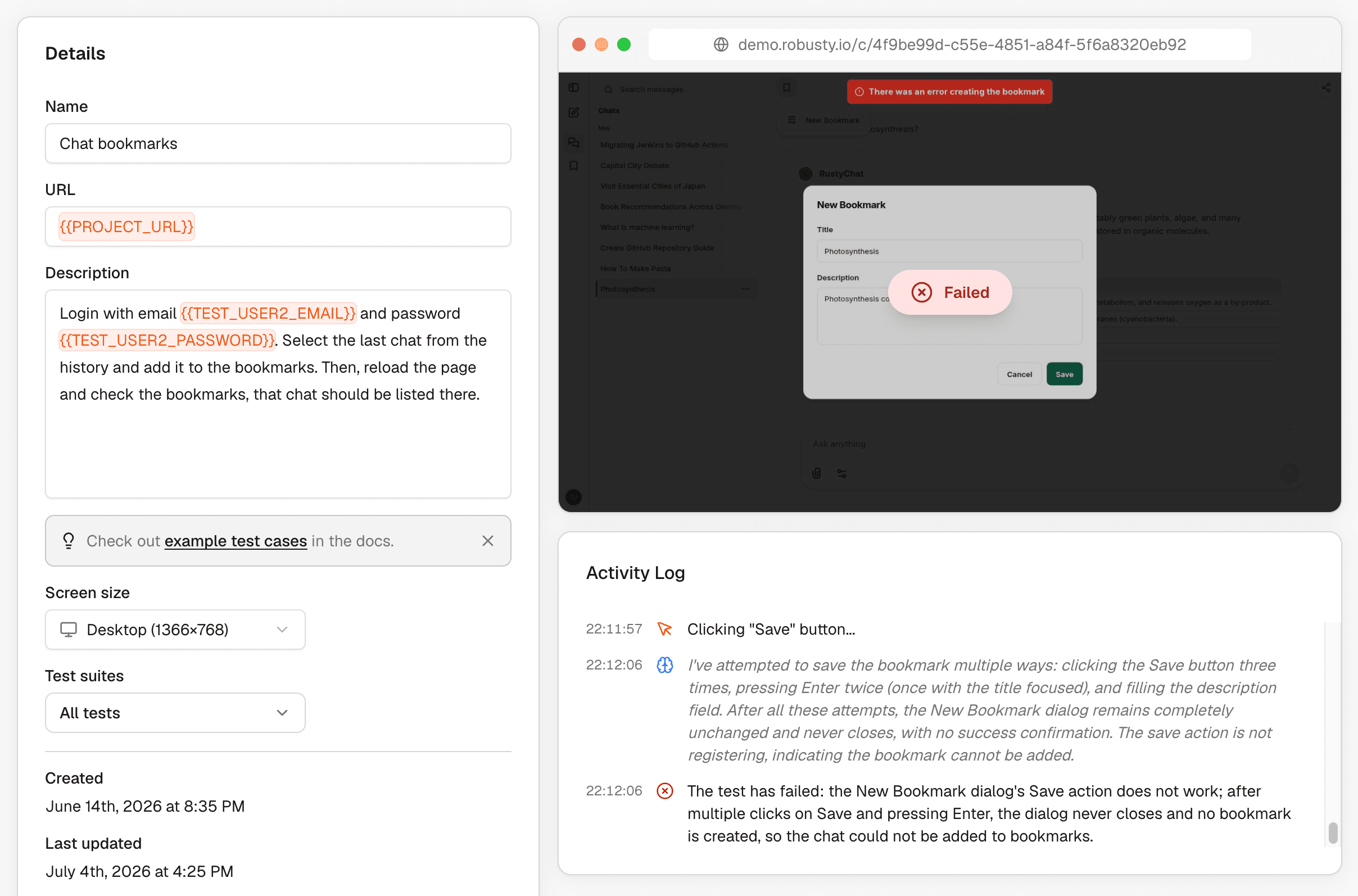
The same approach works for any regression that only becomes visible after completing a real user journey: describe the starting state, the actions a user takes, and the result that must still be true.
What should a release regression suite cover?
Here are just a few examples of workflows you can test before a release:
- Authentication, account recovery, and onboarding.
- Creating, editing, saving, and deleting important user data.
- Permissions and workflows for different account roles.
- Checkout, billing, and subscription changes.
- Integrations and actions that depend on external services.
- AI features such as chatbots, assistants, and generated content.
Make regression failures easy to investigate
A failed regression test should tell the team more than whether a check passed or failed. Robusty records the browser session, including the interactions and screens that led to the result, so developers and product teams can inspect the same evidence without first reproducing a vague bug report.
Group critical scenarios into a release test suite and run them on demand before shipping or integrate them into your CI/CD pipeline. Every test in a suite runs in parallel, keeping release checks fast as coverage grows.